Kitty vs. Daylily; Or, the time I accidently almost killed my boss’ cat

daylilyMy yard is filled with blooming daylilies right now, one of my favorite garden plants. Easy to care for, they spread quickly and are always bright and cheery. But this annual display of color brings back a dark daylily memory from just a few years ago….

Our director, Karen Simone, used to live a few blocks from the poison center. She was preparing for a trip and wasn’t going to be coming in to the office that day and I had some documents for her to sign. I thought I would take advantage of the beautiful day and walk them to her. Along the way I passed a patch of blooming orange daylilies and decided to pick one for her. When I got to her home she signed the documents and took the flower, putting it on top of a console table in the entry.

About a half an hour later I got a panicked call from her, asking what the flower was that I brought.

Karen’s cat, Ivan, is nationally known for eating all things plant-based. I say nationally known because he was actually featured in a Heathcliff comic strip because of his love of vegetables. It was pretty common for Karen to come in with a whole pepper or tomato with a little kitty bite out of it.

So what flower did I bring to the cat whose favorite snack is plant matter? The one flower that could bring a cat to its knees.

Poor Ivan was rushed to the vet, where he refused to throw up, even though he was given several medications to make him. He finally did, hours later, and big chunks of stem and flower (along with a mystery pink gummy object) came up. He spent the next couple of days on IV fluids while the vet kept an eye on how his kidneys were doing.

So what is the deal with daylilies? There are many plants that are harmless to some animals, but can cause serious harm to others. Every animal’s body processes things a little bit differently. Daylilies are safe for humans and dogs, but can cause serious problems in cats. It’s important to know what house plants you have and what’s growing in your garden. Keep track with a label in the plant or a list with pictures in case someone eats a plant. If you have an animal or small child around call the poison center to see if what you have is poisonous to them.

Ivan lived to tell the tale of his adventure with the daylily, and continues to eat everything in sight.

Posted in National News, Poison Prevention, Regional News | Tagged , , | Comments Off on Kitty vs. Daylily; Or, the time I accidently almost killed my boss’ cat

State of New Hampshire secures funding for 2012-13!

In a down-to-the-wire move Monday, the New Hampshire Legislative Fiscal Committee approved an emergency re-budgeting, securing the needed funding to keep poison center services for the state for one more year.

This means that as of July 1, people in New Hampshire will still have a place to turn to for help if they are poisoned.

We’d like to thank the many who wrote letters or made phone calls to show their support for poison center funding!

Despite the good news, it is important to note that this funding is only for July 2012 through June 2013, and is not intended to be a permanent source.  New Hampshire will need to find stable state funding to continue services.

How can you help?

Sign up for our newsletter NNEPC News to keep up to date on the status of funding for the following year, and if there are any actions your can take to show your support.

Interested in being a poison center champion?  We’re looking for your stories about using the poison center and what it’s meant to you.  Email me at mahert@mmc.org

Posted in National News | Comments Off on State of New Hampshire secures funding for 2012-13!

Bath salts update

Bath salts” are in the news again, as Miami police suspect these synthetic drugs were involved in the recent face-eating incident.

Legislatures and law enforcement across the country are taking measures to try to control the use of these dangerous drugs, which can cause severe paranoia and hallucinations in people who use them. Most recently, the U.S. Senate added an amendment to an FDA bill that would classify bath salts as Schedule I drugs, making them illegal to distribute. There is still a long way to go before this becomes law: the amendment still needs to be adopted by the House of Representatives and then the bill will need to pass both houses and be signed by the president.

In the meantime, the U.S. Drug Enforcement Administration has issued an emergency order that bans bath salts. Closer to home, Vermont first took action against bath salts last August, while Maine passed an initial law in June before strengthening it with new laws in September and April.

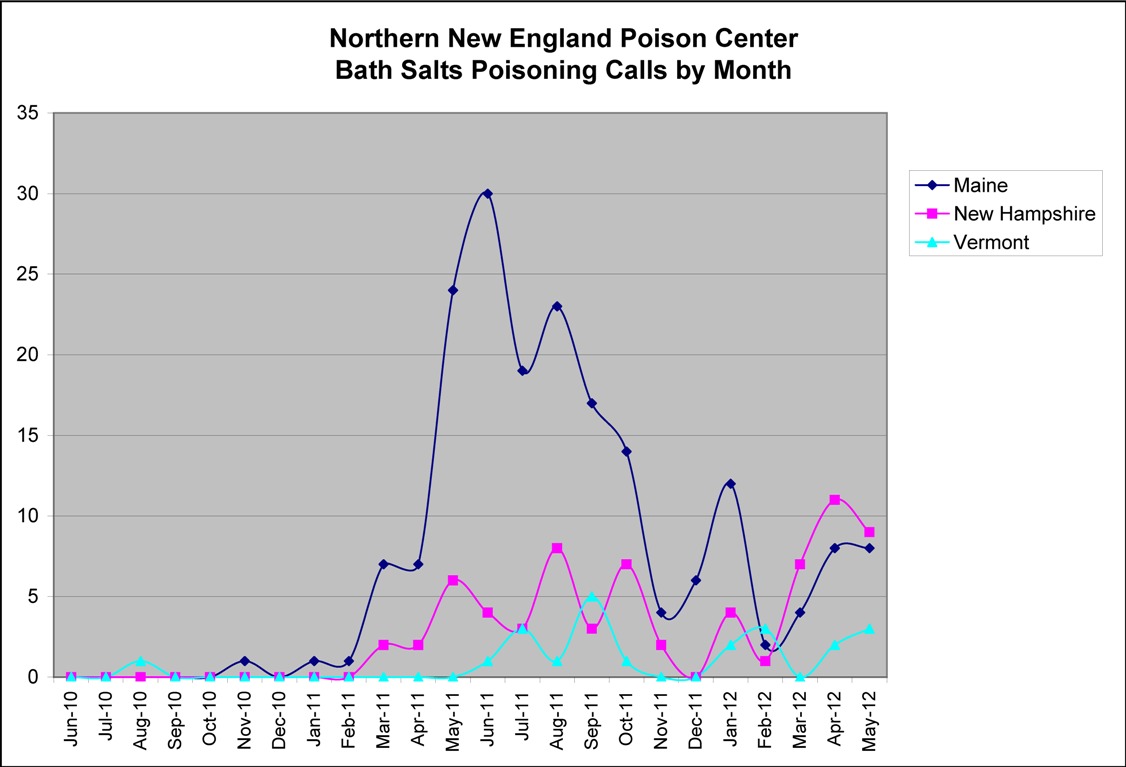
The local laws seem to have made a difference. Calls to the NNEPC regarding bath salts peaked last June and have been on a general downward trend since.

However, it’s possible that as hospitals have become more familiar with bath salts, they are calling the poison center less often for treatment advice, so fewer calls doesn’t necessarily mean less use.

We also saw an uptick in bath salts calls in April and May, especially in New Hampshire, and we’ll continue to monitor this to see if it is a trend. New Hampshire has no local laws about bath salts, and police in the border town of Berwick, Maine, recently stated that they are dealing with bath salts users who bought the drugs in New Hampshire.

While behavior as extreme as what happened in Miami is not common, people who are high on bath salts are often a danger to themselves and others. If you think someone is high on bath salts, do not go near the person, especially if you are alone. Call the police or 911 for assistance. If you can’t avoid the person, Lt. Tom Reagan of the Bangor Police Department offers the following advice:

  • Give the person space
  • Use a calm voice
  • Only ask simple questions

Further reading: The Christian Science Monitor took a look at the recent incident in Miami and the most recent information on bath salts. NNEPC Medical Director Dr. Tamas Peredy was quoted.

Posted in National News, Regional News, Substance Abuse | Tagged , , | Comments Off on Bath salts update

NNEPC monitors laundry pod calls

The NNEPC is continuing to watch for serious effects in little kids getting into laundry pods.

We took a close look at our cases involving these products. Since March we’ve received 15 calls about children getting into these products (8 in Maine, 5 in New Hampshire and 2 in Vermont). Almost all of them—14 out of the 15—were treated with advice from the NNEPC and did not need to see a doctor. Only two of the children had nausea or vomiting. One did go to the hospital, after getting it their eye, and did have significant irritation. Otherwise, all the children were just fine.

We will continue to monitor calls about these products. The NNEPC is working with other poison centers to closely review calls to find out how often these products cause more than just minor issues.

Posted in National News | Tagged , | Comments Off on NNEPC monitors laundry pod calls

Laundry detergent single-use packs: Are they dangerous?

The American Association of Poison Control Centers just released information about some very scary poisonings in young children from swallowing one of the newest developments in household products: the laundry pod, a small, brightly colored pack of liquid. Three cases involved children who had severe vomiting and problems breathing after swallowing the products.

So, how bad are they? Usually not too bad. We have had several cases at the NNEPC, none of which were nearly that serious. Most children bite into the packs and get some of the product in their mouth. Some break the packs and get the product in their eyes or on their skin. Most of our kiddos did not seem to have problems. A couple threw up, even though they only swallowed a small amount.  One had significant irritation in their eye. None of them had problems breathing. It’s too soon to say, but it seems these products are usually not too bad for most kids. In unusual cases, the result can be more severe.

What should you do? 

1. Keep laundry pods and packs out of the sight and reach of children. These products contain very strong detergent. The packaging is attractive and kids may find it interesting to go after. Knowing that very young kids tend to put everything in their mouth, squeeze it, push on it and sometimes step on it, it’s better not to have it nearby where it might be tempting.

2. Call the poison center at 1-800-222-1222 right away if your child gets one of these products in their mouth, on their skin or in their eyes. Drinking a small amount of water, removing clothes, washing the skin or flushing the eye may prevent a lot of problems. The poison center can walk you through the right steps.

3. If your child does have trouble breathing or isn’t responding to you, call 911. However, this type of reaction is not common.

Posted in National News, Poison Prevention | Comments Off on Laundry detergent single-use packs: Are they dangerous?

Single-load packets of laundry soap dangerous to children

The American Association of Poison Control Centers is encouraging caregivers to keep new single-load packets of laundry detergent out of the reach of children. Some children who have swallowed these packets have needed to go to the hospital.

Read the AAPCC’s press release [PDF] for more information.

Posted in National News | Comments Off on Single-load packets of laundry soap dangerous to children

NNEPC Sets Up Central Location for Information on NH Funding Crisis

The NNEPC established a webpage- www.nnepc.org/new-hampshire-funding-crisis to give concerned NH residents a place to go to get the latest information on the situation.

If nothing changes, in 51 days poison center services will be shut off for those calling from the State of New Hampshire. After July 1st there will be no answer on the 1-800-222-1222 hotline for calls placed from New Hampshire. The State of New Hampshire has told the NNEPC they are as yet unable to financially support services. The NNEPC is working closely with state leaders to find funds, but nothing has been secured at this time.

What can you do to help?

1-Call the Governor’s office and let them know that you are concerned about the Poison Center and that you want to know what is happening to make sure you don’t lose poison center services.

Governor’s Office 603-271-2121, ok to leave a message

2-Call their State of NH (not federal) Senators and House Representatives to tell them you are concerned and want to know what is happening.

Find your legislator

Contact your legislator

3-Check back with us for news and other actions you can take to help support this cause!

Posted in Medication Safety, National News, Poison Prevention, Regional News, Substance Abuse | Comments Off on NNEPC Sets Up Central Location for Information on NH Funding Crisis

Hand sanitizer: Good for public health, bad for drinking

Hand sanitizers are in the news this week following this Los Angeles Times report about teenagers showing up in emergency departments after drinking hand sanitizer.

Most hand sanitizers are alcohol-based, and like any product with alcohol in it, drinking enough can give a person a “buzz” or make them drunk.  Because of the scents and other ingredients in hand sanitizer, it tastes terrible. This is often (but not always) enough to keep little kids from drinking harmful amounts, and it deters most older kids who want to experiment, as well.

Kids are creative and persistent, though. In the LA Times piece, the students made the gel hand sanitizer into a liquid using salt. In 2011, the NNEPC received calls about students using powdered drink mix instead of salt. (It turns out even fruit flavoring won’t mask the nasty aftertaste.)

It’s important to remember, though, that hand sanitizer has great public health benefits. The increasing availability of alcohol-based hand sanitizer in public places has likely helped slow the spread of viruses, like the ones that cause colds and the flu. 

As always, the best tool for keeping kids from abusing alcohol and other drugs is communication. It’s important for kids to know that household products and medication can be just as dangerous as illegal drugs. For tips on talking to your children about substance abuse, visit the National Institute on Drug Abuse or the Partnerships at DrugFree.org.

For more information, see our A to Z entry on hand sanitizer.

Posted in National News, Poison Prevention, Regional News, Substance Abuse | Tagged , , | Comments Off on Hand sanitizer: Good for public health, bad for drinking

NNEPC New Hampshire funding at risk

New Hampshire residents are in danger of losing access to their poison center. The State of New Hampshire has informed the Northern New England Poison Center that it no longer has the funds necessary for the center to provide hotline services to the state.

The Associated Press has more (via the Boston Globe):

CONCORD, N.H.—Mothers, doctors, school nurses and others who rely on New Hampshire’s poison control hotline in emergencies will have to turn elsewhere if funding isn’t found to keep the line open after July 1.

Karen Simone, director of the Northern New England Poison Center, said Tuesday that $600,000 is needed to keep the line open in New Hampshire. She said the federal homeland security funding that has been used can no longer be used for the service. She said Vermont and Maine are not affected because those states pay for their hotlines with state or other money.

New Hampshire’s Department of Health and Human Services has told the center it does not have the money.

Simone said hotline supporters are trying to secure funding before July 1, but nothing has materialized.

If you are a New Hampshire resident, please contact your state legislators to let them know how important poison center services are to you.  Keep an eye on our blog for more updates on this situation.

Posted in National News, Regional News | Comments Off on NNEPC New Hampshire funding at risk

Maine bans additional synthetic hallucinogens

On Monday, Maine Governor Paul LePage signed a bill that bans additional synthetic hallucinogens related to bath salts. The bill was sponsored by Democratic Rep. Bobbi Beavers of South Berwick.

NNEPC Director Dr. Karen Simone talked to the Portland Daily Sun about the new law:

[I]n the world of poison prevention, the new law is likened to an arms race with manufacturers to ban an ever-varied assortment of toxic ingredients in the so-called “designer drug” market.

“It’s basically the market adjusting to the laws and then us trying to adapt to the market,” said Dr. Karen E. Simone, director of the Northern New England Poison Center based in Portland.

Read the full Portland Sun article or view the full text of the new law.

Posted in Regional News | Comments Off on Maine bans additional synthetic hallucinogens

Poison prevention and public health: Little steps can lead to big changes

April 2-8 is National Public Health Week. This year’s theme is “A Healthier America Begins Today: Join the Movement!” The goal is to encourage people to take preventive measures to improve their lives. There are five main themes, one of which is “A healthier America begins with living tobacco- and drug-free and preventing alcohol abuse.”

Take these little steps to prevent alcohol and other drug related poisonings:

• Program you cell phone with the poison center number, 1-800-222-1222.

• Keep medications and alcohol up high and out of the reach of young children. Take the pledge at www.upandaway.org.

• Make sure teenagers cannot access alcohol and medications in your home. Consider a locked cabinet. Keep track of how much alcohol and medication you have.

• Be a good role model. Avoid binge drinking, use of illegal drugs and the misuse of prescription medications.

• Get rid of unwanted or expired medications.

• If someone you know needs help with a substance abuse problem, find substance abuse treatment in your community at 1-800-662-HELP (4357).


Posted in National News | Tagged , | Comments Off on Poison prevention and public health: Little steps can lead to big changes

National Poison Prevention Week’s golden anniversary

With March 18-24 marking the 50th anniversary of the National Poison Prevention Week it is a good time to look back on where we have done and what we still need to do to prevent poisonings.

In 1962 when National Poison Prevention Week was established poisoning deaths among children under 5 years of age were a significant public health concern. Today, there are 90% fewer poisoning deaths among children in that age group than there were 50 years ago. This is a result of a number of poisoning prevention success stories. Here are just some of them:

1962 – President Kennedy first proclaimed the third week in March as National Poison Prevention Week to aid in encouraging the American people to learn of the dangers of accidental poisoning and to take such preventive measures as warranted by the seriousness of the danger.

1970 – Congress passed the Poison Prevention Packing Act. This act required child-resistant packaging on toxic household products such as lighter fluid, paint thinners, mouth wash, drain cleaners and medications.

1982 – The tragic Chicago Tylenol tampering case led manufacturer Johnson & Johnson to make tamper-proof, triple-sealed safety containers on all its Tylenol products within months. Other manufacturers did the same shortly after.

1993 – Battery-powered carbon monoxide detectors for household use arrived on the market.

2000 – President Clinton signed the bipartisan Poison Control Center Enhancement and Awareness Act authorizing $140 million over the next 5 years to fund the nation’s poison control centers.

2002 – The Health Resources and Services Administration launched the nationwide, toll-free poison center number, 1-800-222-1222.

2003 – The American Academy of Pediatrics recommended no longer using syrup of ipecac to treat poisonings in the home.

Even though we celebrate the great strides made in preventing poisoning deaths among young children, we need to prepare for the significant challenges that we face now and in the near future:

More people die of poisonings than motor vehicle crashes.

Nearly 9 out of 10 poisoning deaths are caused by drugs. Drug poisoning deaths have increased 500% since 1980. Middle-age males are the age group most likely to die from a drug poisoning.

Abuse of synthetic marijuana and bath salts among young adults has increased dramatically in the last two years, resulting in harm to themselves and others while they are high.

State and federal funding for poison centers continues to be cut, meaning there are fewer staff and educational programs available to educate the general public and health care professionals about how to prevent poisonings and likely resulting in more people unnecessarily using the emergency department to treat their poisonings.

So where do we go from here? How do we plan to continue our success in addressing poisoning trends? One way is to embrace new communication tools. This month the NNEPC launched a new website and an online chat service. In addition to calling the poison center at 1-800-222-1222, website visitors can now chat with a trained health care professional 24 hours a day about their poisoning or poison question.

What can you do to help us spread the word and prevent poisonings? For starters:

1. Program your cell phone with the poison center number, 1-800-222-1222.

2. Visit our poison information index to learn more about poisons and how to prevent poisonings. Share the link with others: www.nnepc.org/poison-information.

3. Subscribe to our blog and sign up to receive NNEPC updates and prevention tips from our newsletters throughout the year.

4. Like us on Facebook: www.facebook.com/NNEPC.

5. Follow us on Twitter: www.twitter.com/nnepc.

Posted in National News | Comments Off on National Poison Prevention Week’s golden anniversary